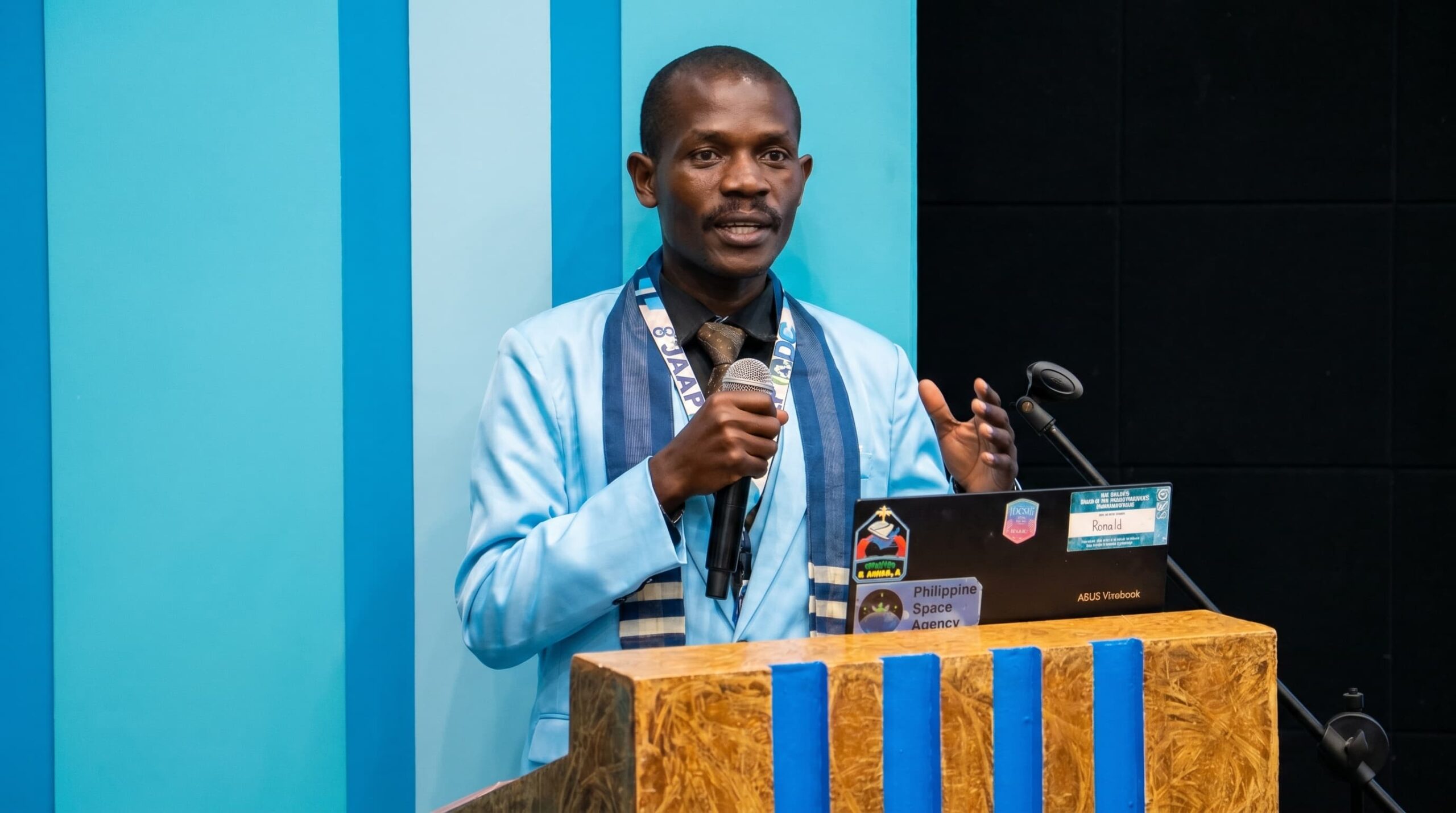
Dumaguete City, June 18, 2026 Late on the first afternoon of the 8th JAAP International Research and Development Conference, after six other speakers had already taken their turn, a faculty member from Bugema University in Uganda, the “Pearl of Africa,” walked up to deliver Lecture 7. What he said next turned a routine reproductive-biology talk into one of the most quietly defiant moments of the entire conference.
“Several scientists have given up on MOET in water buffaloes,” Dr. Ronald Nuwasasira told the room. Then, with deliberate emphasis: “But for us, we CANNOT AFFORD TO GIVE UP. I REPEAT, WE CANNOT AFFORD TO GIVE UP.”
It would have been a striking line from anyone. From him, it landed differently because, as he reminded the audience himself, Uganda doesn’t currently have water buffaloes at all. He was standing in a lecture hall in the Philippines, representing Bugema University and the Mighty Pearl of Africa, building a case for a species his own country doesn’t yet raise purely on the conviction that the science, and the global partnerships behind it, were worth fighting for anyway.
For Bugema University, this wasn’t just another conference slot. It was “the Mighty Bugema University” his words standing shoulder to shoulder on an international stage with Central Luzon State University and the Philippine Carabao Center, two of the most established names in buffalo reproductive science in Asia. A faculty member and Teaching Assistant from the Department of Animal Science, currently completing his Master of Science at Central Luzon State University, Dr. Nuwasasira used his moment at the podium to do something conferences rarely allow: he made the science personal.
His talk, Unlocking the Potential of Multiple Ovulation and Embryo Transfer (MOET) in Water Buffaloes, tackled a problem that sounds technical but carries real stakes for farmers across Asia and, he hopes, eventually Africa. Water buffaloes provide milk, meat, and draught power to agricultural economies across the region but compared to cattle, their reproductive systems fight back at almost every stage: fewer ovarian follicles, “silent” heat that’s nearly impossible to detect, lower sensitivity to the hormones used to trigger multiple ovulations, and ovulation rates that can fall as low as 5.6%. It’s the kind of biology that has a way of grinding research careers down. Dr. Nuwasasira’s response was to name the failure rate out loud, and then argue forcefully for why it was still worth solving.
Strip away the emotion, and the talk was a tightly argued case for treating buffaloes as their own species rather than a cattle substitute. Buffaloes display 1–2 follicular waves per cycle versus cattle’s 2–4. They typically yield just 2–4 embryos per flush, against cattle’s 5–7. Their cervix is narrower, their uterine horns deeper, demanding gentler, more precise handling at every step of embryo recovery. Where conventional wisdom might say “adapt the cattle protocol and hope,” Dr. Nuwasasira’s review pointed to something more exacting: descending-dose FSH regimens, GnRH pretreatment to improve ovarian response, optimized prostaglandin timing, and direct LH administration each one a small correction aimed at a biological system that has resisted standardization since the first live buffalo birth via embryo transfer in 1983.
His conclusion was unambiguous: modified FSH protocols significantly outperform conventional approaches, in vivo-derived embryos still beat lab-grown ones on pregnancy rates, and the path forward runs through exactly the kind of international cooperation that brought him from Uganda to Dumaguete in the first-place shared genetic resources, harmonized protocols, and regional centers of excellence built on partnership rather than any one country going it alone.
What set the talk apart wasn’t only the science but also how Dr. Nuwasasira chose to close it. Rather than the usual list of acknowledgments, he asked the room for something more: that the ideas shared at NORSU not stay trapped inside its lecture halls. “Good ideas kept inside are like rice stored too long,” he said. “They dry up and lose their use.” He wanted what was “planted” at the conference to travel to Bugema, to Central Luzon, to wherever the next researcher willing to keep going might be listening. He thanked his co-authors and mentors by name, Dr. Peregrino G. Duran and Dr. Danilda Hufana-Duran, whom he called his “highly esteemed Philippine mother” and academic advisor, and thanked Bugema University and Central Luzon State University for releasing him from his duties to make the trip at all. “Without their approval,” he admitted, with a flash of humor, “I would still be stuck behind my desk, probably counting papers instead of enjoying this experience.”
Stripped of ceremony, Dr. Nuwasasira’s appearance at the 8th JAAP-IRDC was a small but telling test of the conference’s own founding theme: Building Resilient Futures: Global Collaboration for Scientific Innovation. Here was a researcher from a university an ocean away from the species he studies, refusing to let geography, low ovulation rates, or other scientists’ resignation be the final word. The buffaloes he’s working to help aren’t in Uganda yet. But thanks to a partnership stretching from Bugema to Central Luzon to the Philippine Carabao Center, the science is already there and waiting.
As he put it himself, closing his talk: may the wisdom shared in that room “spread like autumn pollen and grow strong and fruitful like spring seedlings, far beyond these halls.”